Simple Home Exercises to Help Your Aching Lower Back
- Jeff Murphy

- Dec 16, 2020
- 4 min read

Most people experience lower back aches and pains. The reason I can say this is because the statistics show that approximately 80% of people in the United States have experienced some form of low back pain in their lifetime significantly enough to see a doctor for it. Many will take pain killers or anti-inflammatory medications to relieve the aching. I am not against taking medications to help relieve the aching lower back. Believe me I know from first hand experience how debilitating lower back aches and pain can be. I have had arthritis in my spine since the age of 13. It would keep me almost bedridden at times. I have also taken medications to help resolve it, but I typically experienced terrible side effects from taking the medications. I quickly realized that pain killers and anti-inflammatory medications were not the solution for my lower back woes. I discovered over many years of study and learning from some really smart people that my solution was through strengthening and stretching exercise and diet. I will limit my discussion for this post to exercises. I will cover diet in another post.
Before I start I want to make a disclaimer. First, the exercises that I provide throughout this post are not a cure. I do not promise they will take away your back aches and pains. These exercises have not taken away my aches and pains because the truth is that there are some conditions that cannot be cured through medicine which includes exercise. I do offer these exercises as a way to relieve your symptoms helping you to be able to move better and continue to improve fitness. My experience with performing these exercises has been symptom relief (my aches and pains have not gone away) allowing me to perform my work, exercises, and feel better without making my pain worse. Second, I offer these exercises as a starting point for a lifelong journey of performing strengthening and stretching exercises to improve your fitness. This means that you will need to make these exercises harder to experience the maximal benefit. Third, if you experience pain at any point during these exercises you must stop and make sure you are doing the exercise correctly. If the pain remains consult your physician. It is ill advised to try and build fitness on pain and dysfunction. Trust me. I know this from experience. My body lets me know through the pain it experiences when I have done too much or done something I shouldn't do with my body.
Now on to the simple exercise. Drum roll please! This exercise has been around for many years, and it is probably an exercise you performed in PE class during school. It is known as the bridge exercise. Before talking you through the key technical points of performing this exercise I want to discuss the reason why this exercise is important to perform and master (I believe not only in performing the exercise but mastering it before moving on to a harder exercise).

Benefits of Performing and Mastering the Bridge Exercise:
Strengthens the gluteus maximus, erector spinae, abdominal, and posterior upper body muscles that provide stability for the lumbar spine. When these muscles are stronger, the lumbar spine becomes more stable.
Stretches the hip flexors and anterior upper body muscles that allow the hip and shoulders to be more mobile giving more stability to the lumbar spine. Hip flexors and chest muscles are prone to being tight because we sit much more as a culture. The flexibility of these muscles impacts the stability of the lumbar spine considerably.
Trains the squat and hip hinge movements. The squat and hip hinge (i.e. toe touch) are a basic movement that we perform everyday of our lives. Performing the sqaut and hip hinge incorrectly impact your lumbar spine health considerably. The bridge exercise allows you to master the important movements needed to squat and hinge better.
So now it's time to discuss the technical aspects of performing this great exercise.
Start Position

Lie face up on the floor. Bend at your knees and hips. I have my toes off the ground to strengthen my anterior shins muscles and stretch the posterior calf muscles. If this is too difficult keep your feet flat on the floor.
Keep your feet even. Feet that are not kept even while performing this exercise can lead to lower back pain and injury.
Press your shoulder blades into the floor and drop your shoulders.
Keep your head on floor and neutral.
Exercise Position:
Lift your buttocks off the floor until the waist is even with knees and chest. Hold this position for no more than 1 second then return to start position.
Keep your shoulder blades pressed into the floor throughout the lift.
Keep your lumbar spine neutral. Many people with bad backs have the tendency to arch their lower back because their hip flexors are tight and gluteus maximus muscles are weak. The best way to prevent this is remember tight butt and tight gut. This means to squeeze your butt cheeks together while keeping your stomach muscles tightened. If you cannot keep the back from arching try this bridge variation shown below. Pulling the knee into your chest will flatten your back allowing you to fully contract your gluteal muscles. You may also need to spend more time with stretches specific to the hip flexors.
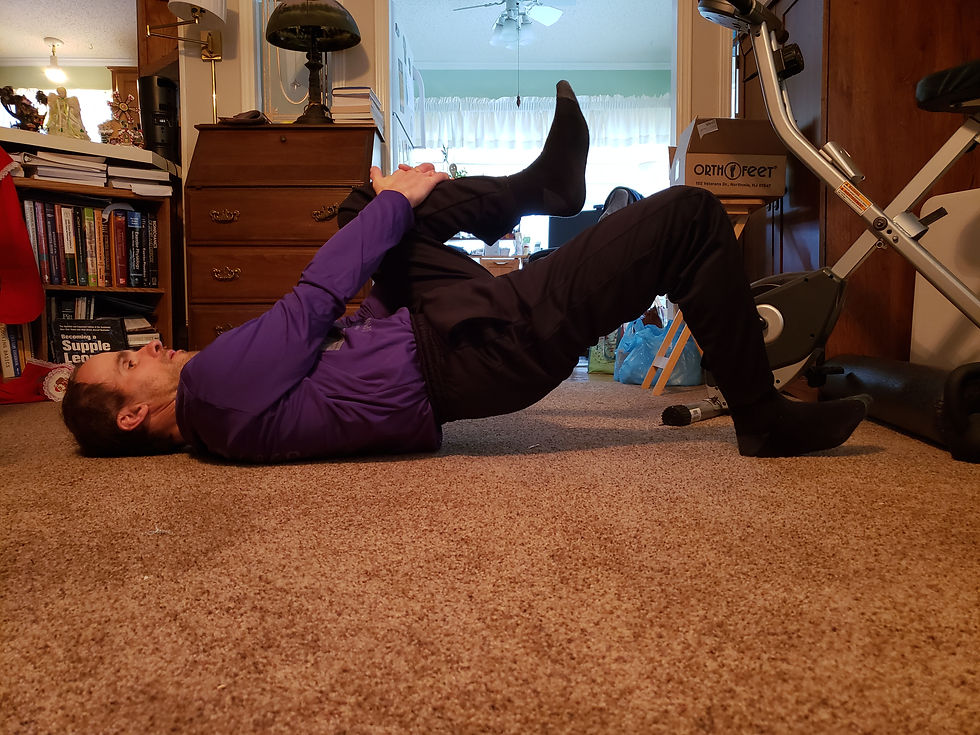
I recommend novices or people that have been sedentary for many years to start with 2-3 sets of 10-15 repetitions, resting 30 seconds between sets. Once that becomes easier increase your repetitions up to 20-30 repetitions. The next progression would be to add a light weight to your waist and lower the repetitions back to 10-15. Single leg bridges are a great progression especially given many of us are prone to use one side more than the other side. There are many more progressions that I will share in future posts. Don't hesitate to contact me if you you are unsure about the exercises. I am here to serve you!


Comments